

What does it take to turn a flea-market find into a brand and an idea into an object with soul?
Doing Goods co-founder Aanyoung opened the doors to her wonderfully colourful world, sharing stories of treasure hunting, trusting her instincts and why perfectly imperfect is often far more interesting. From chance encounters and creative partnerships in India to the making of those wonderfully quirky rugs we can’t resist, this is the story behind the objects and the people who bring them to life.
1. Doing Goods began with Aanyoung and Jan, a shared love of travel and a belief in objects made with character. When you were first starting out, how did you learn to trust your own vision before knowing whether others would see what you saw? And what ultimately gave you the confidence to turn that instinct into a business?
Aanyoung: I don’t think we started with a big vision or even with the confidence that this would become a real business. We are heart people and we’ve always let the heart lead.
The first little seed was planted in 2008 when I was living in Beijing studying Mandarin. Jan came to visit and we found these beautiful vintage Chinese cabinets at Panjiayuan flea market. We spent pretty much all our savings, bought about ten of them and shipped them back to Rotterdam. We had no idea if they would even arrive, let alone whether anyone would want to buy them. But they did arrive, and we sold them. That was probably the first moment we thought: maybe there is something here.
From there, we just kept going. We travelled, went to markets, found crafts and objects that made our hearts beat faster, and sold them at markets and pop-up stores.
I always found it so hard to sell these treasures. I still remember a little tiger statue I found in Java. It just looked at me from the shelves, covered in dust. I brought it home to sell it, but once I put it in the store, I took it back. I couldn’t let it go, and it’s still in my home now, haha.

Tiger Statue
At one point, we started creating our own pieces inspired by our vintage finds. We realised it was hard to build a business around one-of-a-kind pieces, so we slowly started producing small quantities of our own designs.
The confidence came from doing. From putting things out into the world, seeing people respond and then taking the next step. One of those moments was Maison & Objet in 2016. We could only afford a nine-square-metre booth, and every time a client walked in, we basically had to step out. But we received 19 orders, including one order so big that Jan and I looked at each other and thought: okay, this could actually become something.
I still believe in that way of building a business. You don’t need to see the entire road ahead. You can’t. You just need to trust your instinct enough to take the first step, and then another one.
That doesn’t mean I’m not scared. I still get scared before big decisions or investments. You just learn to follow your heart and do it afraid.

2016 - Maison & Objet
2. Starting a business with your husband or wife is quite different from choosing a business partner. What has building Doing Goods as a couple brought to the business that you don’t think a traditional partnership would have?
Aanyoung: I think the biggest advantage is that Jan and I know each other inside out. We have been together for 23 years. We don’t have the same strengths at all, which is probably why it works.
Jan is very strong on the big picture, finance and operations. I come from a design background and am much more focused on creativity, product and brand, but I also love the commercial side and making things more efficient. We can challenge each other because we naturally look at the business from completely different angles.
There is also a huge amount of trust. Well, he trusts me more than I trust him, haha, because I am definitely the control freak. Sometimes one of us sees something the other doesn’t see yet, and after all these years, you learn to give each other the space to follow that instinct.
As for separating business and life, we were never particularly good at that! Especially in the beginning, Doing Goods was our life. We worked weekends and evenings, travelled together, packed orders, built trade show booths and talked about ideas over dinner, in bed and in the car. The business grew up alongside us.
That has changed since having our twins. We’ve become much more conscious about where we put our energy. Every yes to something is a no to something else. We both love being parents, and spending time with our kids is incredibly rewarding.
I love this quote from Alain de Botton: “There is no such thing as work-life balance. Everything worth fighting for unbalances your life.”
I couldn’t agree more. So perhaps the balance is actually in the imbalance. There are weeks when we work full-on, day and night. But we are also at a stage in the business where we can take a month off and travel with our twins while the business continues to run perfectly well without us. To me, that is the ultimate success.
Doing Goods is part of our family story. I don’t think we would really know how to completely separate the two.

Jan and Aanyoung Portrait
3. India is such an important part of the Doing Goods story, but why India? What first drew you there, and when did you realise it was somewhere you wanted to build lasting creative relationships?
Aanyoung: India actually wasn’t part of some grand plan either. Before India, we were sourcing a lot in Indonesia and travelling all over the place looking for things that inspired us.
Our relationship with India started with Narendra Singh and his family. We were receiving endless emails from suppliers at the time, but for some reason his stood out. We had a call and decided to take a chance on a small first order. It was $500, I still remember it well. Everything arrived perfectly, so we thought: we need to go and meet these people.

2014 - India Sourcing
That first trip turned into three weeks travelling through India together. We didn’t have much money, so we shared costs, stayed in simple places and just learned. I completely fell in love with the richness of the craftsmanship. I used to work in kids’ fashion, so I had seen many factories all over the world, but the craftsmanship of home accessories in India was something completely different. There are so many techniques, materials and generations of knowledge there. It opened up a whole new creative world for me that I still can’t get enough of.
But what really made us stay was the people. We grew together with Narendra and his family, step by step. Today, the Doing Goods workshop in India is over 3,000 square metres and around 60 people work there, while hundreds more people are involved in making our products outside the workshop.
The relationship is very different from a traditional supplier relationship. When we visit, we stay at their home, eat homemade food and drink Kingfishers at night.
When they visit us, we take weekend trips together as families. We talk about the challenges in life and always reminisce about everything we have been through together. How our paths crossed, what that has meant for all of us and how much both our lives have changed because of it.
4. When something is made entirely by hand, no two pieces can ever be completely identical. Has there ever been a challenge in getting people to see those differences as part of an object’s story rather than something that needs to be “perfect”?
Aanyoung: Absolutely. We live in a world where we have become very used to machine-made perfection. So when something is handmade and one piece is slightly different from another, the first reaction can sometimes be: is something wrong with it?
For us, it’s exactly the opposite. Those little differences are evidence of the hands that made it.
A block print might not line up with absolute precision. A brass piece can have small variations from the casting process. A hand-tufted rug will never be completely identical to the one next to it. That is what we mean when we say perfectly imperfect. Every piece carries a little bit of the person and the process behind it.
But our biggest pride, ‘handmade with love’, is also one of our biggest challenges. Handmade takes time. And in India, family, tradition and celebrations are incredibly important. So sometimes your products are delayed because of a festival, or samples don’t arrive because someone’s brother is getting married. Personally, I love this. My parents are from Hong Kong and we value family over everything too. Yet from a business perspective, you can imagine it can be a real challenge at times.
We try to show that process as much as possible because once you understand how something is made, you look at those little irregularities differently. Quality doesn’t have to mean that 1,000 pieces look exactly the same. It can also mean knowing that somebody spent time learning a craft, working with their hands and making something that is meant to last.
So irregularities stop being flaws and become part of the story. For me, that is where a lot of the beauty is.

2025 - Aanyoung India Workshop
5. We’re big fans of Doing Goods rugs at Soroka, and one of the things we love is how much personality they can bring to a room. Take us behind the scenes: how does a rug go from an idea to something we eventually unroll in the shop?
Aanyoung: Ideas can really start anywhere. I’ve always been a treasure hunter, so inspiration can come from a flea market, a trip, an old book, a colour combination in a restaurant, an animal, a piece of vintage textile or something completely random that catches my eye.
Our design process at Doing Goods isn’t very linear. After more than 20 years of working as a creative, I feel like I’ve built this enormous library in my head. I’m constantly pulling things from it and combining them with whatever is right in front of me, or sometimes with a centuries-old craft or technique from India. Somehow, all those different references come together and become something new.
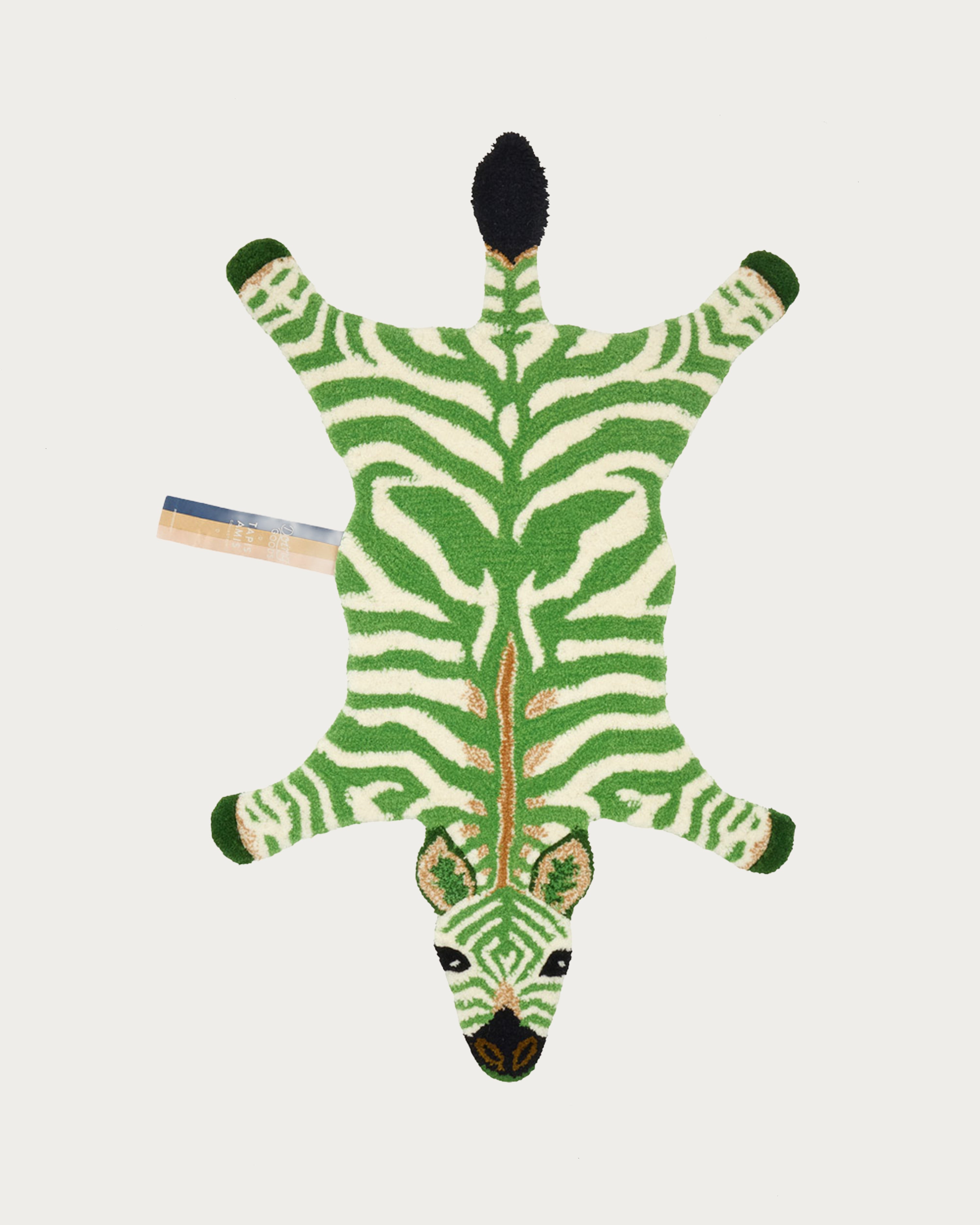
With Tapis Amis, there always has to be personality. They are animals, but they are characters too. We give them names like Archie Check Bear, Loony Leopard and Drowsy Tiger. They’re a little quirky, sometimes funny, and hopefully they make you smile every time you walk into a room.
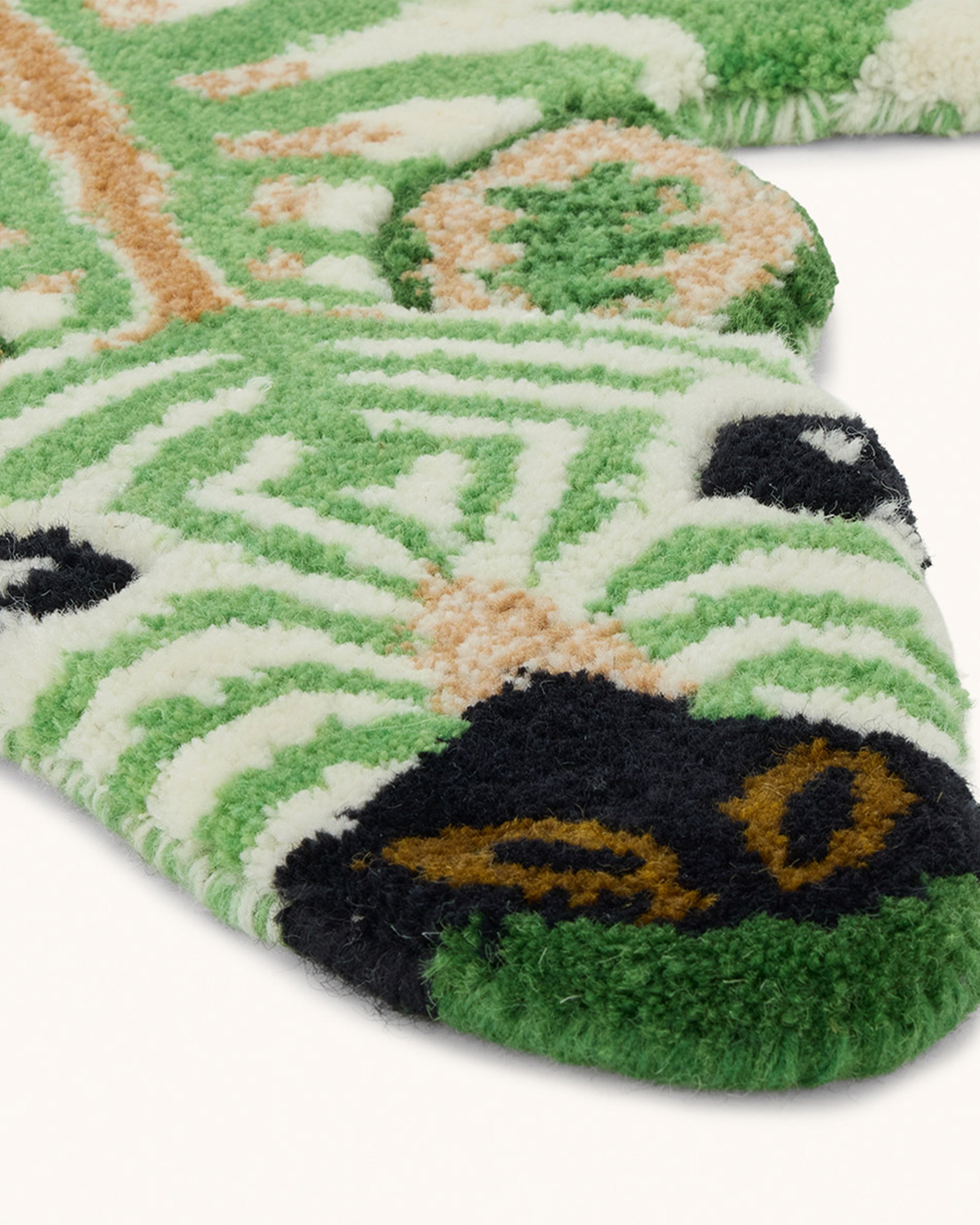
Once we have the design, it goes to our team in India. The design is carefully drawn onto canvas and then the rug is hand-tufted, colour by colour, using New Zealand wool. After that, the cotton backing is attached, the edges are finished and finally the whole rug is shaved and trimmed by hand.
And yes, samples definitely go wrong! Sometimes the proportions feel strange, a colour suddenly doesn’t work at full scale or the expression of an animal is completely different from what we imagined. But that’s part of designing, and sometimes those mistakes actually lead you somewhere better.
What I love most is that we create the design in the Netherlands, and then an artisan in India looks at it and brings their own eyes, hands and interpretation to it. So the finished piece becomes a combination of our design world and their incredible craftsmanship. You can see the love and patience that has gone into making it, and I think that’s what gives it its soul.
That moment when a sample comes back and it’s exactly right never gets old. I still get excited. After all these years and thousands of products, there is still that very simple feeling of: yes, that’s the one. I hope I never lose that.

Archie Check Bear Rug