

August marks our founder Jamila’s birthday month and we’re celebrating by putting her in the hot seat.
We asked Jamila seven questions to take us a little deeper into the wonderfully colourful world behind Soroka — from how she discovers the objects that make it into the shop and why she believes they carry energy, to her love of long dinners, meaningful rituals and the magic of bringing people together.
1. What do all the objects at Soroka have in common, and what do they say about the way you like to live?
Jamila: Apart from the obvious — being really happy and colourful — every time I choose an object, I pay a lot of attention to symbolism. If it carries certain signs, motifs or patterns, or even in the way the colours are mixed together, for me there’s a certain kind of vetting process to make sure that it’s all positive. It’s about protection and positive energy, and I pay a lot of attention to that when selecting an object.
It often stems from the maker themselves as well. When we have conversations, it’s their energy and how they translate that into their art pieces, their collections or the patterns they design.
I believe that all objects carry energy, so it’s very important to me what we put in the shop and that everything carries a similar energy. I hope that when someone purchases an object, they take a little piece of that into their home.
I always imagine that if someone has quite a neutral environment and they bring an object from Soroka into it, it’s almost like a little glitter bomb explodes in the corner of your home. Glitter, for me, symbolises happiness, sparkles, magic and just positivity.
So whether it’s a small candle, a matchbox or a really beautiful large centrepiece on the table, whatever the size, I hope it brings this little speckle of joy. Every time you look at it, it kind of brings you into the spirit of Soroka.
I think that energy is very much linked to my personality as well. Regardless of what’s going on in my personal life, how many hours I’ve slept or how stressed I am, whenever I’m with other people — whether it’s my kids, my friends or clients in the shop — my mood is always to bring your best.

If you’re having that moment with your child, you give them that light. People often say to me, “You’re like a speckle of joy or light whenever you’re around,” and I think I take a lot of pride and put a lot of energy into enriching a person’s life and making them feel light, airy and happy. I think that’s what interactions should be about.
People should share their best with each other in order to lift each other up and ignite passion. If someone is feeling bad, you come in and try to get them out of it and pull them up.
Of course, I have my moments too, and I have my very private ones who do the same for me when I need it. I also have my other methods — spirituality, well-being, forest walks and all of those things that charge me up.
But I think through my objects and through my personality, it’s very much about igniting that passion, good spirits, lots of light energy and just positivity.

2. You’ve spent years discovering makers, artists and objects from around the world. Has your definition of good taste changed over time?
Jamila: I think what’s funny is that the initial concept of Soroka was drawn — I tend to draw these kinds of brainstorms, like a crazy web of ideas and objects and paintings and whatever else, with little pictures. The first map came about in 2013, and I think nothing has changed since then. It was the same spirit of objects, the same direction of colour and joy.
I don’t think it’s so much about taste. It’s more about becoming savvy and knowing where to find these beautiful gems. Really good makers don’t necessarily need to be online, they don’t need to be screaming about themselves, they don’t need to be at trade shows. They kind of find their way of being discovered by people.
I think the more practice you get, the more you’re able to tap into these undercurrents and find the really small makers and the really unique objects. That’s what I’ve mastered over the years.

I’ve also probably mastered the skill of having that eye — yes, no, yes, no. I know almost immediately whether something fits the collection in store or doesn’t. Before, I think it took me more time. I wasn’t as certain. With age, you also become more comfortable with your decisions and more confident in what makes up your world.
I very much think that Soroka is an extension of my inner state, so I always stay true to it. Even if there are people who admire what we’ve created but haven’t necessarily tapped into the concept themselves, I never change course because of someone’s opinion. I think the most important thing for any brand or space is to stay true to what you set out to do.
So I always tap back into that: What was it that I set out to do? Am I aligned? Yes, I am. And I continue forward.
I don’t think there is necessarily an ideal of taste. It’s about what feels right for the concept and what you set out to do, and ensuring that everything you do fits within that initial thought.
Every person has their own taste, and I never really judge. Some people have very white environments that they live in, and that’s what works for them. Our shop is obviously full of colour and craziness. Some people don’t like objects in their home, whereas in mine there isn’t a single centimetre of shelf that isn’t decorated with some sort of object.
I don’t think it really matters how you build your world around you. Everyone is different.
What I hope is that the people who need that sparkle we spoke about earlier — that joy, that boost, that speckle of glitter and magic — come to us and we provide that for them. It’s not so much about taste, but almost this way of life that we share. We infuse this happiness into their daily life, they take it on and, hopefully, through the dinners they have in their homes, they share it with the people who come into their world too.
It creates this ripple of joy.
It’s about passing on the energy and spirit of all the objects and the concept. It’s never, “I’m a tastemaker, I’ve acquired a fine taste, please be part of my taste.” Not at all. It’s about passing on that energy and this joyful way of being.

3. What’s the most beautiful object you’ve ever found unexpectedly, and why has it stayed with you?
Jamila: I don’t think I’ll ever be able to define one object as the most beautiful. The only way I can really talk about it is through the moment in my life when I came across a specific object.
There are two specific points in my life when I found these almost symbolic objects that are now part of my home and remind me of those moments in time. One of them is an ashtray in the shape of the letter G, which I found randomly at a market.
At the time, I was at a crossroads with my other business, which carries a name beginning with G. I was really uncertain about which direction to take. One way was to put more energy and effort into it and make it more than what it was back then. The other was to leave it small, at its basic level, and focus on other things.
I remember being in Paris, which is one of my best cities to recharge and rewire. I know for many it is just a city, but for me, it’s probably the only place where I can spend an infinite number of days alone, browsing and finding things.
I was walking along one of the streets in the city centre and came across one of those random sales on the pavement. Someone was probably just selling their unwanted items, and my eye instantly fell on this ashtray.
I really believe that objects enter your life at certain points to send you a sign and encourage you to continue on a certain route. As soon as you become fine-tuned to picking up those signs, seeing how they guide you and then watching how things work out, I think it becomes a really magical way of finding the objects that are right for you.
The ashtray itself is a combination of silver and gold. This was many, many years ago, and it was one of the first times I had seen those two metals mixed together so beautifully. Now you see it in trend reports, in jewellery, everywhere — but at the time, it instantly attracted my eye.
Then there was the fact that it carried the letter G and had this 1970s Italian look, which is one of my favourite visual directions. Whenever I’m looking at vintage pieces, I always go for that era.
It felt like quite a powerful object. I could imagine it sitting on the table of my office in a much bigger, more established world. In a way, it led me to put more energy into the business and choose the route of growing it into something bigger.
And rightly so, because it turned out to be the right route and it paid off. So I really think that object marked a turning point for me.
It’s still in my home, on my work table. Every time I glance at it, it gives me that little boost of power — a reminder to trust my gut feeling and go with what I feel is right for me, for the moment and for the business.

4. When you walk into someone’s home for the first time, what’s the first thing you notice?
Jamila: For other people’s spaces, it’s very much about the energy you feel in someone’s home. It’s not so much about the objects because I never really judge people’s environments or their taste — whether it’s too dull, too white, too this or too that.
I think it’s fascinating to be able to enter someone’s environment. It’s like a little peek into their soul and what they’re made of. For me, it’s always fascinating to explore.
It’s the way the objects are arranged on the shelves, how they make a meal, how they pour you tea. It’s everything. It’s in the rituals within their space and, obviously, the objects that form it. Every person manages to put their own slant on their home, and I find that really interesting.
Even if I see an object that’s been purchased from my store, I’m always interested in the space it finds in someone else’s environment. If I bring someone an object from Soroka, I love seeing where it ends up and what they choose to do with it. That’s always really unique.
What is constant when a Soroka object ends up in someone’s home is that you can instantly see it. I see it, and those who start to understand the signature look of Soroka start to spot it too.
Regardless of the category — whether it’s a children’s toy, a book, a piece of homeware, a small matchbox or a large centrepiece — you can instantly tell that it’s a Soroka item. I think that’s so, so special, and I’m so proud of that.
It’s like you’re walking around and suddenly you see this glistening object in the corner, and that’s it.
But what’s also really interesting is seeing how people bring these objects into their own spaces and what they choose to do with them. A vase might become an ice bucket, for example, and we’ve seen some really crazy uses over the years.
I’m really, really excited by this whole concept of people, their homes and their spaces. There’s never a wrong way of doing it — it’s always fascinating.

5. If you could create your perfect dinner party, what would the table look and feel like?
Jamila: I come from a culture where we have very long dinners. We sit at a long table, we share all the food in the middle, and we eat over several hours. Then you always have a central dish of some sort, which comes an hour or two after everyone has sat down, and it becomes the focal point.
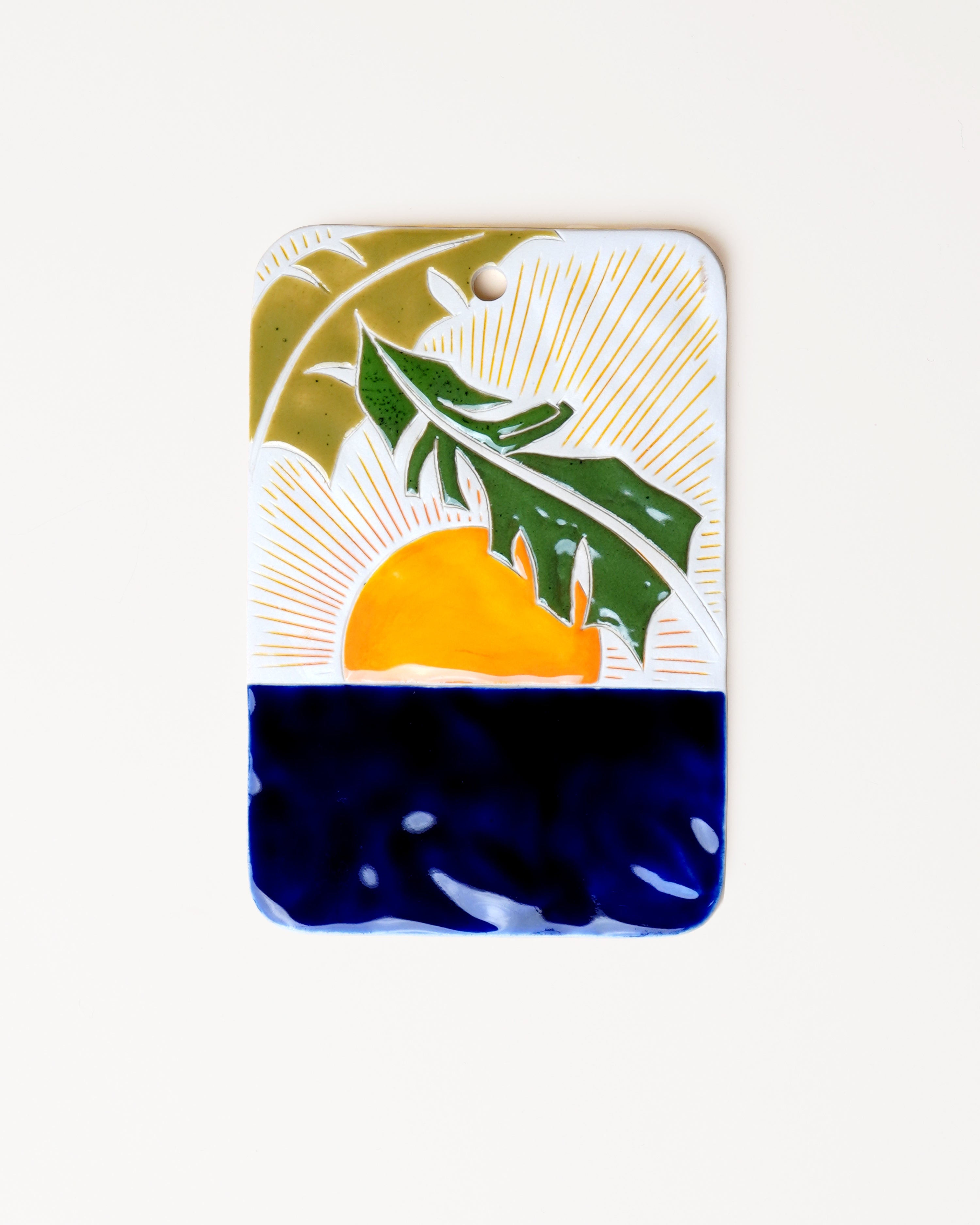
It’s always brought in on this very special platter. It could be passed down through generations, or it could be something you’ve picked up on your travels. Every time you change that centrepiece, and often, depending on what the dish is, you form the story around it.
My husband is Italian, and one of my favourite dishes that he makes for me is pasta vongole. So when we do pasta vongole, I bring out all my Mediterranean-inspired dishes. I’ll have those heavy, thick, irregular glasses for water. I’ve got these beautiful purple and dark green tumblers for wine. Then you’d have a central platter from one of the makers — usually Patrizia Italiano is my go-to for that Italian scenic feeling.

When we have desserts, it becomes more about little accents of Murano glass. I use pieces from Vetrofuso, with their beautiful platters that almost look like they’ve been infused with smoke, with this marble effect that’s so gentle and so beautiful. You put a simple, beautiful cake on top, and that’s enough.
Or if you go more towards my roots, which are Azerbaijani, you might have a big dish with thick handles and beaded details. We work with makers who have this aesthetic, including some of our Egyptian makers. There will often be an evil eye somewhere, which brings in that symbolism.
Then I would bring out a beautiful rice dish. We have over 80 different recipes, 80 different styles and ways of making rice. It could be one with dried fruits and chicken, for example. There would have been hours and hours of preparation and cooking, and then it comes out like the king or queen of the night on this beautiful central platter.
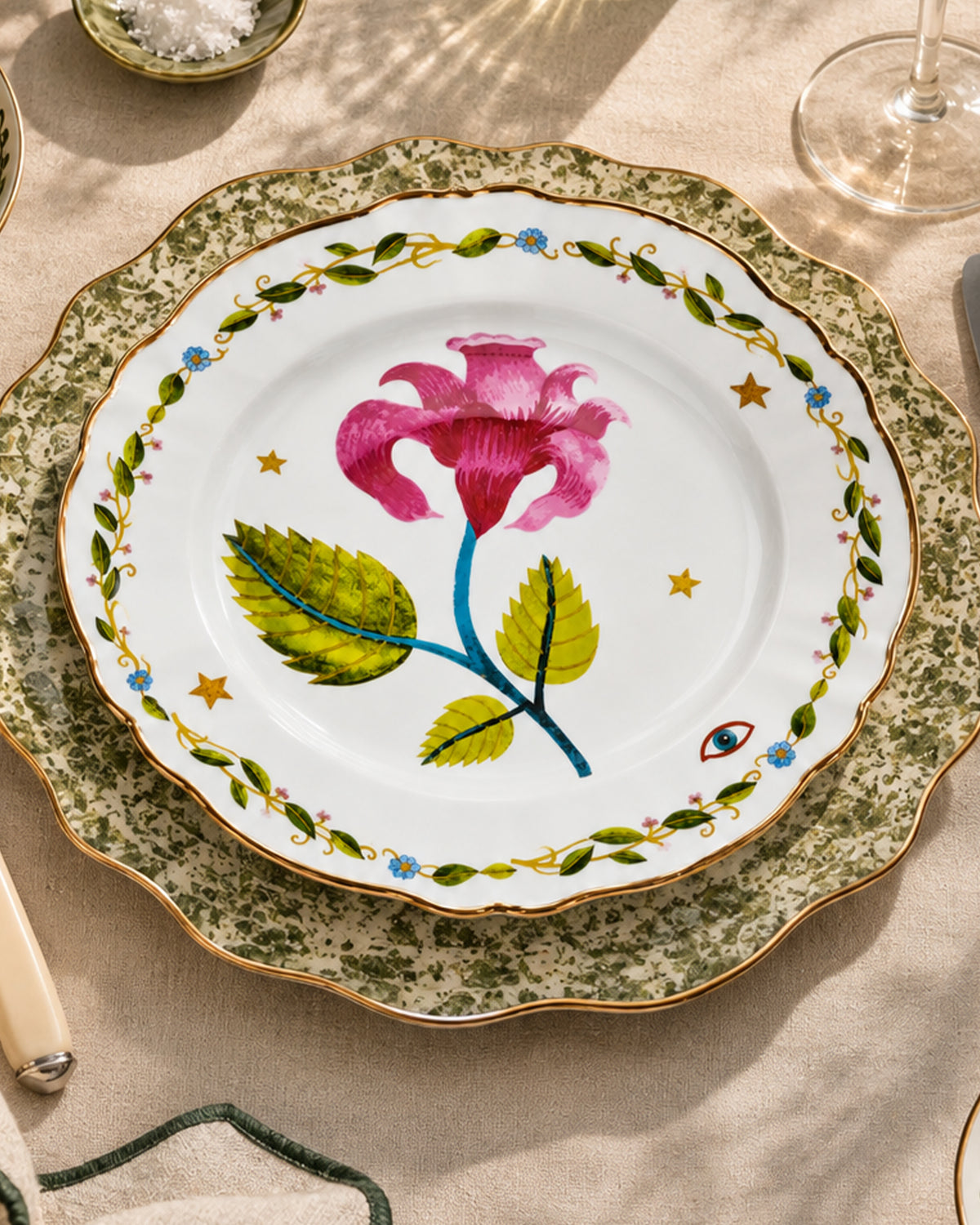
Around that, it becomes more about the table linen. I love it to be very patterned, detailed and sometimes embroidered. Then I actually keep the glasses and plates quite simple — really nice transparent glass and white plates, perhaps with some irregularities in the ceramic.
I’ve gone into real detail, but I pay a lot of attention to these things.

6. Soroka has always felt less like a shop and more like a collection of discoveries. When you’re choosing new brands, what are you really looking for?
Jamila: Every section in the shop is different in terms of what I’m looking for, but they’re all united by the same spirit of Soroka.
Home, which I would say is our main category, is always about the quality of execution and the colour combinations — alongside the energy, spirituality and symbolic elements of some of the pieces we hold. It needs to feel properly made. There needs to be a thought process behind the design, storytelling behind it, and colour combinations that feel intentional and thought through.
Many of the objects we hold take months to make, and you can feel that when you hold them and bring them into your space. You feel that someone has been working on them and crafting them. It’s the same with our tablecloths — designs that are often block printed or embroidered and have taken hours and hours to make.

I think it’s the infusion of all that effort into the design process, the ability to layer these objects together and the complexity within each piece. It’s a kind of beautiful complexity.
Modern gifting is completely different. It’s light, bright and easygoing, and 99% of it is about humour, sarcasm and that slight cheekiness — whether it’s quirky wording on a plate, a little bum cheek somewhere or just something unexpected that makes you smile.
It’s mood-lifting and easy to gift. Even the way we choose our postcards is a little nod to what we’re about: life is too short to be heavy all the time. It should feel like a quick gulp of fresh air and a kick of good mood.
Then, with the kids’ category, it’s about enriching their beautiful little minds with this way of thinking. They’re such beautiful little sponges when they’re small. There are so many makers and beautiful brands out there, often really small and independent, that put so much thought and creativity into how they share even quite complex ideas with young minds.
In our books, we talk about emotions from a very early age. Even our play doughs are made from the most beautiful mixtures — they’re non-toxic, they come in beautiful colour variations and are infused with little additional objects. At every point, it’s about unlocking creativity and encouraging them to explore.
None of it is about making mistakes. It’s about pushing yourself and not treating any experiment as a mistake. It’s about freedom of expression. All of those things form the kids’ room.
And then well-being is where I get to be a bit of a spiritual goddess and healer, which I love. It’s probably where my energetic side — and hopefully my ability to sense and pass on good energy — is used at its peak.
There are loads of great founders, great books and easy-to-use games and decks that help deal with some of the more difficult emotions. Then there are all the lotions and potions, and you get to be this miraculous creature, layering everything together. I don’t know, it’s just great. It lifts my mood and I get all girly.
I love that room. It has a special vibe. I often hear people coming into the well-being room laughing and giggling, and I’m so happy that we’re able to evoke that emotion in them.
Each category is a different part of me, and that shapes the way I curate each one.

7. Finally, after another year around the sun, what’s something you’ve learnt about creating a beautiful life that has nothing to do with buying beautiful things?
Jamila: I don’t think I can exclude the shop from my life. I can’t separate Soroka from it because it’s like I am Soroka and Soroka is me.
What I’ve learnt this year is the importance of connecting to people and continuing to create. Yes, we have a beautiful online shop that we put a lot of effort into, but it’s what happens within the store itself and the shape that it's taking that is so important to me.
Every year, we’re so, so lucky that in all our locations we build real value through the relationships we create. Clients become friends. They come into our spaces sometimes just to have a chat. We have lovely, lovely clients who even bring chocolates for the girls in the team. They share something with us that is much, much bigger than a transaction.
It’s no longer just about selling objects.
I think it all stems from this real pleasure in creating moments for people, spreading the right sort of energy and creating this ripple effect of joy. And I think it does work. With every year that I dive further into this, I understand that it all comes back to that. It’s the moments you create.
We had a magical moment around Christmas when a gospel choir performed in our London store. It was a miserable, miserable day — it was London, so you can imagine. It was raining outside, it was cold, and people were coming in and finding this little light in the darkness.
People were gravitating towards that light and the music. We were having lovely warm drinks, gathering together and sharing this joy. Some people were crying, some were laughing and smiling.
It was such a beautiful moment, and one of those moments that you take as a sign that what you’re doing is beyond the objects. It becomes a world.
I don’t want to use the word “community” on purpose because I think it’s been used and reused too many times. For me, it’s about the moments you create for people and how you draw people together. Then they exchange something with each other.
Whether that exchange lasts a minute, an hour, or they become more regular visitors, it’s about the feeling you provide to that person and the connection you get out of it. That is so, so magical and valuable.
That’s what I want to continue doing, and that’s what I will do for as long as Soroka exists. With every year, I’ll probably find new ways, new ideas and new concepts through which I can create that feeling for all our visitors, followers and the people who appreciate what we do.